
Peter Lynch Lessons: A Basic-Fit Case Study on Investing in What You See
#3 Patient capital. Driven by the discipline of learning.

Dear Partners,
In the investing world, you’re constantly overloaded with theories and data. Most investors know the feeling: the deeper you dig, the more you drown in information. It becomes harder and harder to filter out what actually matters. That’s why we take a different approach in the serie ‘‘Patient capital. Driven by the discipline of learning’’. No complicated noise—just a focus on the lessons and concepts that actually move the needle for your returns.
Today, we will discuss the power of marketing and how you can identify trends within an environment you understand, using the theory of Peter Lynch. For those interested, I will illustrate this using a case study of Basic-Fit.
In this legendary clip, Peter Lynch explains why your daily observations on the street are your greatest advantage as an investor:
Introduction
A company that executes effective marketing builds brand loyalty and customer satisfaction, which directly contributes to a strong market position and the ability to stay ahead of the competition. For an investor, the effectiveness of marketing campaigns is a direct indicator of management quality and their ability to allocate resources efficiently. Companies that fail to adapt their marketing strategy to changing consumer preferences risk losing their relevance, inevitably leading to a decline in market share and profitability.
A lot of time in investor analysis is spent studying the economic moat and the valuation of the company, but what is often underestimated is the power of strategic marketing. I am now reading Peter Lynch’s book One Up on Wall Street for the second time, and as individual investors, we have multiple edges over the professionals:
‘‘The best opportunities can be found at the local mall or in one's own place of employment; individual investors have the chance to identify potentially successful companies long before professional analysts discover them.’ - Peter Lynch
Observing your own environment is one of the most powerful tools for an investor, because consumer trends are often visible on the street long before they appear in official quarterly figures. Phil Fisher supplemented this with his ‘Scuttlebutt method’: by talking to customers, suppliers, and even ex-employees, you get a holistic view of the corporate culture and the actual quality of the sales organization that is not found in an annual report. Some example investments I missed out on, despite understanding the business and use the products on a daily basis:
Spotify
Netflix
Apple
These missed opportunities taught me a valuable lesson: simply using a product isn’t enough. You have to translate those observations into an analytical framework.
This is why conducting a comprehensive market analysis is so vital, it helps identify growth opportunities that have not yet been priced in by the broader market. By recognizing unmet customer needs, you can anticipate the success of new products and services before they are fully reflected in revenue figures. Furthermore, market research provides insight into customer price sensitivity, which is crucial for assessing a company’s pricing power (If Netflix raises its price by €2 and nobody cancels, then price sensitivity is low…).
Case study: Basic-Fit
I have personally experienced an interesting trend with Basic-Fit. In my early years as an athlete, I trained at their clubs, but I was far from impressed. The facilities felt outdated, and the overall experience was mediocre at best, which eventually drove me to look elsewhere. At the time, the people in my enviroment were also equally negative; it felt like a 'budget-only' choice where price was the only redeeming factor, rather than quality or atmosphere."
It is important to understand that Basic-Fit isn't targeting the 'hardcore' bodybuilder. Instead, they focus on the mass market—the average person looking for an accessible way to stay fit. This is a deliberate strategic choice.
However, in my opinion, a turning point occurred. In recent years, management has worked hard to improve the company’s image a change that is easy to observe yourself. The outdated look has been replaced by a modern, clean interior and significantly better equipment.
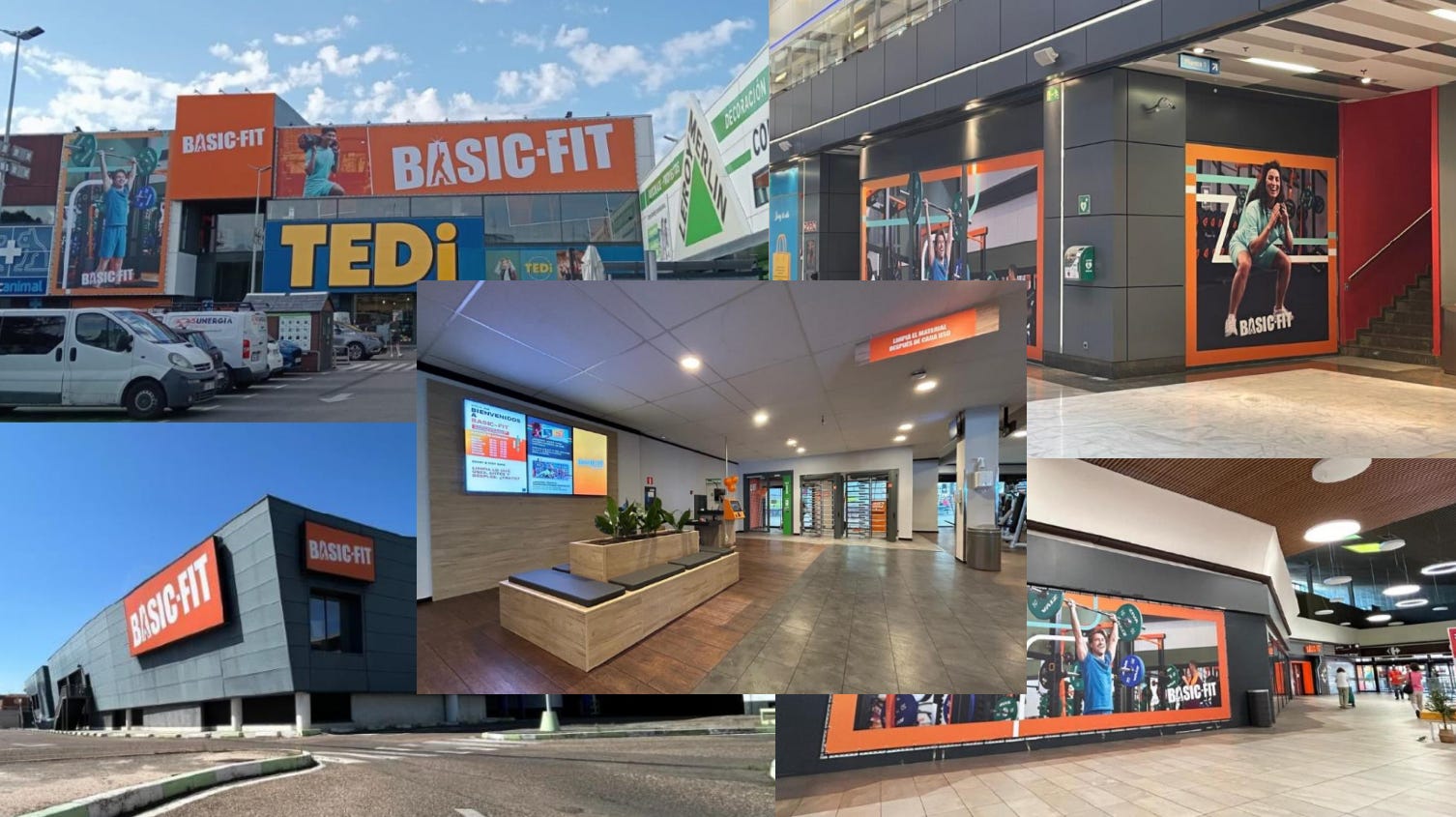
This transformation is clearly visible in the shift toward a ‘High quality estate’ and ‘State of the art equipment’ seen in the latest club designs. What immediately strikes me as an investor is the focus on transparent quality: management steers sharply on Google ratings, a metric that you as an external investor can also track perfectly yourself to monitor customer satisfaction per region.
‘In 2025, we saw an average Google rating of 4.4 versus a rating of 4.0 for the full year 2024 and 3.8 for the full year 2023.’ - CEO Basic-Fit Rene Moos
People in my own environment are also much more positive about Basic-Fit as a gym than when I left 5-6 years ago. This qualitative shift is backed up by the ‘Engaging Member Journey’ data, which shows that the average ‘Length of Stay’ (retention) has increased to 24–25 months—nearly double the international fitness market average of less than 12 months ans compared to the 15 to 16 months at the time of the IPO in 2016.
The Phenomenon of the Orange Backpack
In my opinion, the Basic-Fit bag is one of the best marketing moves out there. Customers has becomed brand ambassadors of Basic-Fit and wear the bag with pride, providing the brand with visibility in people’s daily lives. All of this is reinforced by the values that Basic-Fit projects: sportiness, accessibility and health. People want to show that they are healthy and active, and the backpack functions as a symbol of this lifestyle.

(Just random samples)
There are now more than 4 million copies in circulation throughout Europe. Recently, the chain even launched a limited edition ‘mini baggy’ to keep the hype alive. Everywhere you go—on trains, at airports, and in cities—you see that orange bag. This is a living example of two powerful psychological principles that Charlie Munger often cited:
Social Proof: Munger stated that people unconsciously follow the herd; we look to others to determine what “the norm” is. When you see that bag at every station, Basic-Fit automatically becomes the default choice for fitness in your brain.
Influence-from-Mere-Association: The bag is associated with an active and healthy lifestyle. Even people who are not working out that day wear the bag to let that positive association unconsciously reflect on themselves—buying, so to speak, a piece of that identity.

(Source: IR Basic-Fit)
* Fun fact: A secondary market has emerged on platforms like Marktplaats and Vinted for these bags. People who aren't even members sometimes want to own the bag purely for its functionality.
Why Marketing is the Engine of Basic-Fit’s Growth
What began as a passive welcome gift has been transformed by Basic-Fit into an active, free advertising campaign that generates millions of impressions daily.
For an investor, this is essential: these ‘walking billboards’ ensure enormous brand awareness without the need for repeated media buying. This lowers the Customer Acquisition Cost (CAC) in the long run.
The result of this integrated approach is directly reflected in the figures. *Again; The average length of stay (LTV) for a member has risen to 24 to 25 months. This is nearly double the sector average of 12 months, and a significant improvement compared to the 15 to 16 months at the time of the IPO in 2016.
By continuously creating a perceived differentiation from rivals, Basic-Fit is better positioned to protect existing revenues against customer churn (the loss of members). Academic research (e.g., McAlister et al., 2007) confirms that strong marketing ensures that new revenue contributes directly to growth, rather than merely filling the gap left by departing customers.
The best part of this analysis? You don’t need a Bloomberg terminal to see it. As an investor, you can identify it for yourself on the street every day.
Scale Economies Shared
Nick Sleep, manager of the Nomad Investment Partnership, introduced a concept that turned traditional marketing theory on its head: Scale Economies Shared. Instead of using economies of scale to maximize short-term profit margins, a market leader shares these savings directly with the customer in the form of lower prices or quality.
The flywheel between marketing and scale:
In this model, the low price and high quality themselves function as the most effective marketing tool. Nick Sleep argues that “investing in price reduction” (price giveback to the costumer) is the most sustainable form of investment because it creates a lasting consumer habit that competitors simply cannot break.
Scale and Advertising Efficiency: The larger the scale, the more powerfully you can advertise at lower relative costs. Basic-Fit is the only player that can spread a national TV budget across hundreds of clubs per country. As a result, their marketing expenditures fell to just 5.0% of revenue in 2024, while their impact (so-called share of mind) only continued to grow. A local player or gym chain with 10 clubs cannot compete with Basic’s millions of euros. An example of such advertising power is that Basic-Fit is the official, four-year fitness partner of the Tour de France (until 2028), including the Tour de France Femmes, Paris-Nice, and Critérium du Dauphiné. * The organization (ASO) and various media outlets often cite a global reach of 3.5 billion viewers throughout the entire Tour de France!

(Advertising Spain; Billboards, busses and airplaines). *Additionally, they advertise via TV, radio, and social media (Internet).
Customer Loyalty and the Loop: Because the market leader in a niche or sector shares economies of scale with the customer, the customer rewards this with loyalty, such as (reduced) churn. This creates a flywheel: 1)lower prices attract more customers > 2)more customers increase purchasing power > 3)economies of scale lower fixed costs per unit > 4)these savings are given back again by Basic, and by now Basic-Fit has a range of subscription models that no other gym in Europe can match.
As an investor, you can validate this process yourself on the street by simply “kicking the tires,” as Peter Lynch advised. When you see that Basic-Fit continues to renovate its clubs while keeping the price aggressively low at €19.99 or €24.99, you are seeing Scale Economies Shared in action. If you see on the street that the offering (clubs, bags, app) keeps getting better for the same low price, you know that the flywheel is spinning faster and the economic moat is being widened.
“Invest in what you know.” – Peter Lynch
Pricing Power
When Basic-Fit executes its marketing strategy excellently and consistently offers new products and services (such as the app, new clubs, and the bags), the company builds a unique form of pricing power.
While I wouldn’t go as far as to say their pricing power is on the same level as a digital giants like Netflix or Spotify, it is undeniable that Basic-Fit is carving out its own space. By continuously creating perceived differentiation from rivals, they are better positioned to protect existing revenues and push through moderate price increases without facing massive customer churn.
For Basic-Fit, this power does not manifest as a simple price hike for everyone, but as the ability to guide new members toward higher-tiered memberships (Comfort, Premium, and Ultimate). We are seeing this process in full swing:
Shifting ARPU (Average Revenue Per User): By emphasizing the value of the Premium membership (€34,99) — for instance, through pass-sharing or additional perks — a large portion of new sign-ups opt for this higher segment.
The ‘Churn Effect’ as a Catalyst: When legacy members on lower-priced contracts (€19,99) leave and are replaced by new members joining at €34,99, the average revenue per member increases significantly without triggering mass churn.
Freedom of Choice as a Psychological Anchor: By offering three price tiers, the cheapest plan serves as an “anchor,” while marketing subtly nudges the customer toward the added value of the Premium or Ultimate packages.
The Potential of Dynamic Pricing: If management successfully rolls out dynamic pricing in key markets, profitability is poised to skyrocket as the company captures higher value in high-demand regions.
As long as Basic-Fit succeeds in making the perceived value grow faster than the price, the flywheel remains in motion. This ability to increase ARPU organically through product differentiation is the ultimate evidence of a strong market position and excellent management.
Conclusion Casteleyn Partnership
My investment in Basic-Fit started simply by looking around and trusting what I understood and saw happening. Thanks to Peter Lynch, I learned that the best investment opportunities are often found right on the street in your own enviroment. The explosion of those orange bags was a crucial signal for me: a trend that the official annual figures had not yet fully caught up with. A company that can make itself visible across Europe in this way possesses something special and holds an enormous reach within a massive market.
Of course, the bag alone was not the deciding factor. The real opportunity arose because the market no longer fully understood Basic-Fit. Due to a period of strategic missteps and poor communication from management, a lot of “noise” was created—even though the company’s fundamentals under the hood were much stronger than the valuation suggested.
The case study I demonstratet that marketing isn’t just an “add-on”; it is the engine of the entire company. Basic-Fit has turned its members into walking billboards. It’s brilliant because it costs them almost nothing, while the brand awareness generated is immense. Simultaneously, they leverage that brand power to subtly guide members toward premium subscriptions. This flywheel is further accelerated by Basic-Fit’s position as the market leader in its niche (Europe). Due to their sheer scale, they can simply invest much more in marketing and club quality than any of their competitors and also being the lowest-cost operater.
I am sharing this story because, as an investor, you don’t need an army of analysts to spot a winner. Sometimes, as Lynch says, you just need to “kick the tires.” Look at the crowds at the doors, notice what students are wearing, and see which brands dominate the streetscape.
“Invest in what you know.” The world around you often tells you who tomorrow’s winners are much faster than any financial report ever could (I highly recommend reading Peter Lynch's books!). *I’ll be working on the final part of the Basic-Fit deep dive once the annual figures are out.
Thank you for reading!
Casteleyn Partnership
Disclaimer: This post is part of our educational series and is not intended as financial advice. All examples and figures are for illustrative purposes only. Past performance is not indicative of future results. Please do your own due diligence.
Do you think WillScot’s "sandbagging" of their 2026 guidance is just a reset after a rough Q3, or has the market already priced in the data center boom with this 17% rally? :)
I’ve subscribed and would be happy to support each other.
Jorrit
My favorite accounting focused short sellers are still short the stock. Have you looked at the related party transactions?